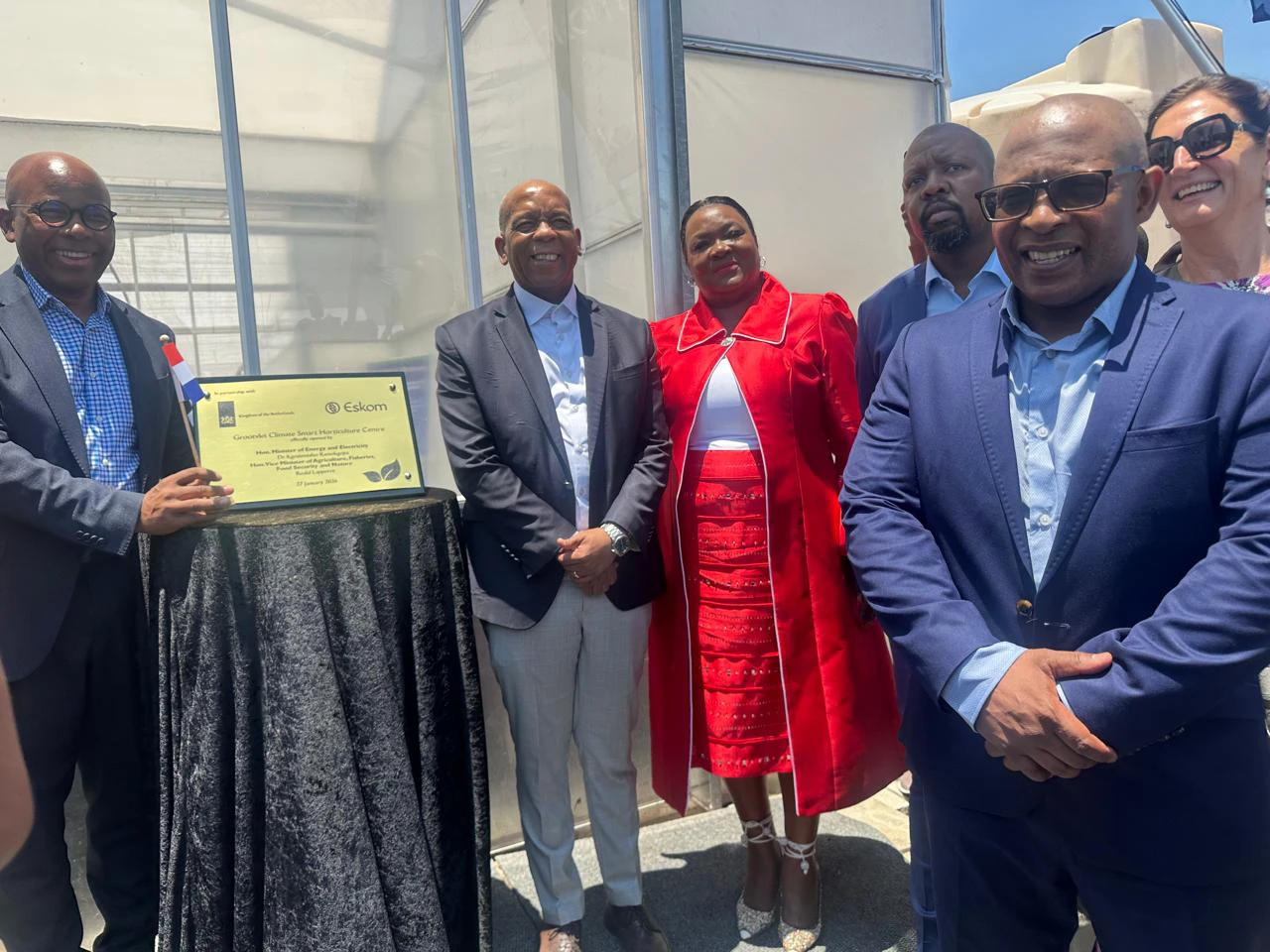
Eskom has officially launched the Grootvlei Smart Horticulture Centre (GCSHC), a flagship project aimed at supporting South Africa’s Just Energy Transition while promoting inclusive green economic growth.
Developed under Eskom’s Just Energy Transition Programme (JET) in partnership with the Kingdom of the Netherlands, the centre repurposes previously unused land in Grootvlei into a climate-smart agriculture hub. Managed by EARN Grootvlei Agric, the project focuses on job creation, skills development and sustainable livelihoods for local communities.
The launch was attended by Minister of Electricity and Energy Dr Kgosientsho Ramokgopa, Mpumalanga MEC for Public Works, Roads and Transport Thulasizwe Thomo, Gert Sibande District Executive Mayor Cllr Walter Mngomezulu, and local leadership led by Executive Mayor Cllr Busi Khanye. The Netherlands was represented by Vice-Minister Roald Lapperre and Ambassador for Business Development Marchel Germann.
Eskom said the project demonstrates that the energy transition is not only about reducing carbon emissions, but also about protecting communities and creating new economic opportunities in areas historically dependent on coal.
The Grootvlei Smart Horticulture Centre is expected to serve as a scalable model showing how energy reform, agriculture and local economic development can work together to support a more inclusive and sustainable future.
For the Dipaleseng community, the Grootvlei Smart Horticulture Centre is expected to bring direct socio-economic benefits, particularly through job creation and skills transfer.
Local residents will gain access to employment opportunities across the agricultural value chain, from production and processing to logistics and support services.
The centre will also provide training in climate-smart farming techniques, equipping young people and emerging farmers with practical skills that improve employability and long-term income prospects.
Beyond jobs, the project is set to stimulate local economic activity by supporting small businesses and cooperatives linked to agriculture and food production. Improved food security, reduced household vulnerability, and the productive use of previously idle land are expected to strengthen community resilience. By creating sustainable livelihoods outside the coal sector, the initiative offers Dipaleseng a more diversified and stable local economy, helping the area transition toward a greener and more inclusive development path.