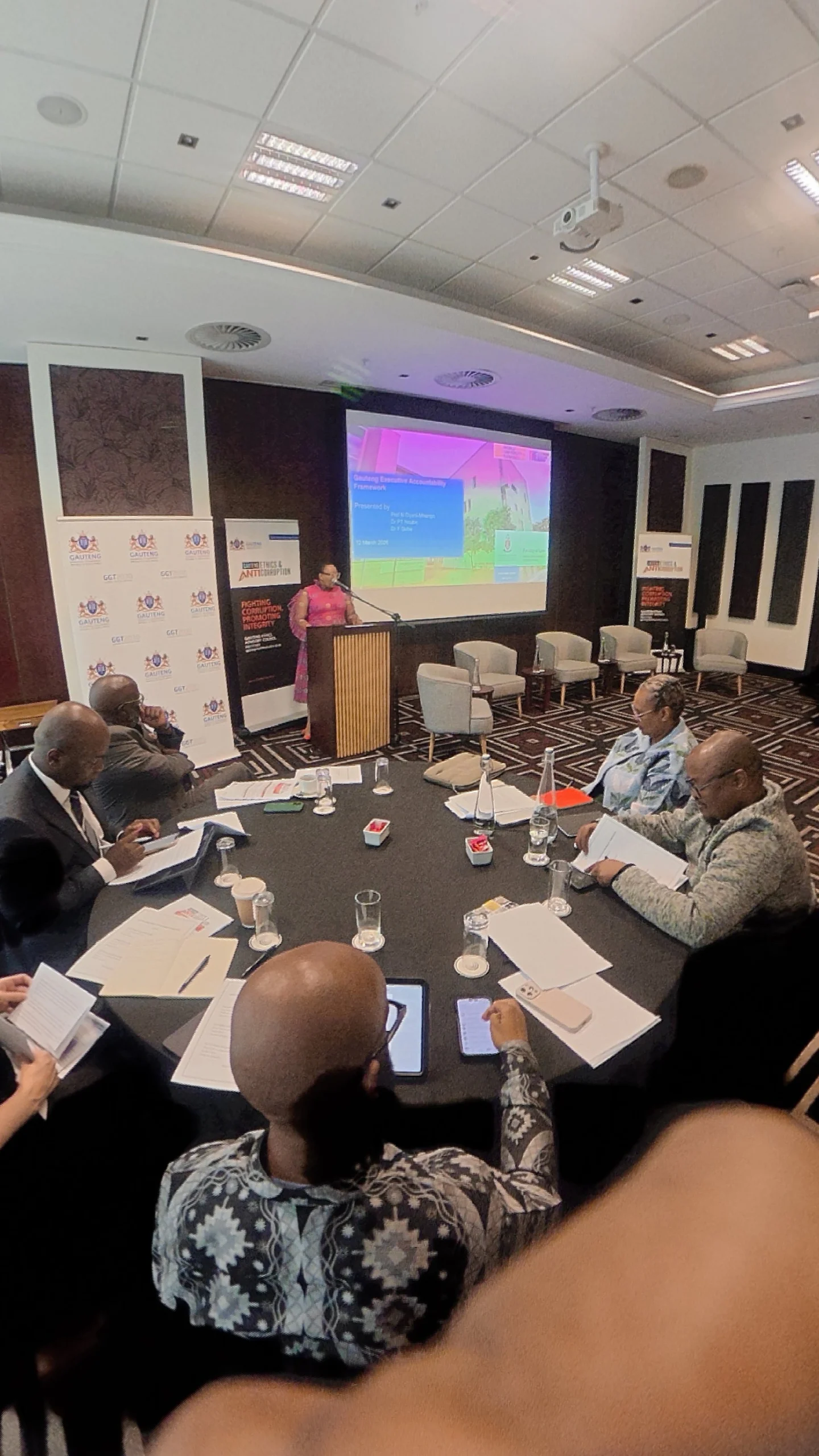
On Thursday, March 12, the Gauteng Provincial Government led an engagement session bringing academics, Policy-makers, civic society and community groups in Sandton.
The Gauteng Ethics Advisory Council (GEAC) has officially moved to bridge the gap between policy and practice, hosting a high-level session to unveil a new framework designed to bolster the accountability of the provincial executive.
The framework, developed in partnership with the University of Pretoria, follows an exhaustive analysis of existing laws and regulations. The initiative seeks to identify systemic gaps and create a more rigid environment for provincial leadership to answer for their actions.
A Unified Front for Governance
The session saw a rare gathering of cross-spectrum leadership, including Acting Premier and Health and Wellness MEC Nomantu Nkomo-Ralehoko (representing Premier Panyaza Lesufi), Speaker of the Gauteng Legislature Hon. Morakane Mosupyoe, and Leader of the Opposition Solly Msimanga.
GEAC Chairperson Rev. Solomuzi Mabuza emphasized that the core mission is simple but profound: “They want officials responsible for their acts,” he stated, highlighting the council’s role since its 2017 inception in collaborating with higher education and policy experts to sanitize provincial governance.
Moving Beyond “Policy Rules”
Acting Premier Nkomo-Ralehoko reiterated that good governance is the bedrock of a functioning democracy. She pointed to existing efforts—such as the Premier’s accountability system launched last year and weekly community engagements—as evidence of progress.
However, she noted that this new framework is essential to “formalize” these measures. “It must be taken to the highest level, to the level of the Chief Director, so they can be taken seriously,” the MEC added, stressing the need for robust monitoring and evaluation.
Strengthening the Legislature’s Teeth
Speaker Morakane Mosupyoe delivered a sharp reminder that the “engine of accountability” resides within the Legislature’s portfolio committees. She called for the Standing Committee on Public Accounts (SCOPA) to be fully empowered to summon the executive.
The Speaker also addressed a critical structural concern regarding the Office of the Integrity Commissioner.
“We can’t have it under-budgeted. We can’t have the Commissioner reporting to the Secretary of the Legislature,” Mosupyoe said. “We are going to make sure we align this and ensure that it remains independent.”
Accountability as a Tool, Not a Goal
Providing an academic lens, Christine Hobden reminded those in attendance that accountability should not be viewed as the finish line.
Instead, she argued that it is a “means to an end”—a tool to ensure that the ultimate goal of effective service delivery and ethical leadership is met.
The session concluded with an open panel discussion led by Former Public Protector, Advocate Thuli Madonsela.
The attendees made collective commitment, from the Office of the Public Protector and provincial leaders to uphold due diligence, ensuring that oversight is not confined to the boardroom but is felt wherever the executive performs its functions.
According to Gauteng, the Framework offers recommendations to enhance executive accountability in the province, based on stakeholder engagement and legal analysis.
These include measures to strengthen institutional accountability, improve the processes of the executive and legislative branches, promote professionalisation and capacity building, increase public engagement and transparency, establish proactive accountability mechanisms, and improve monitoring and evaluation.