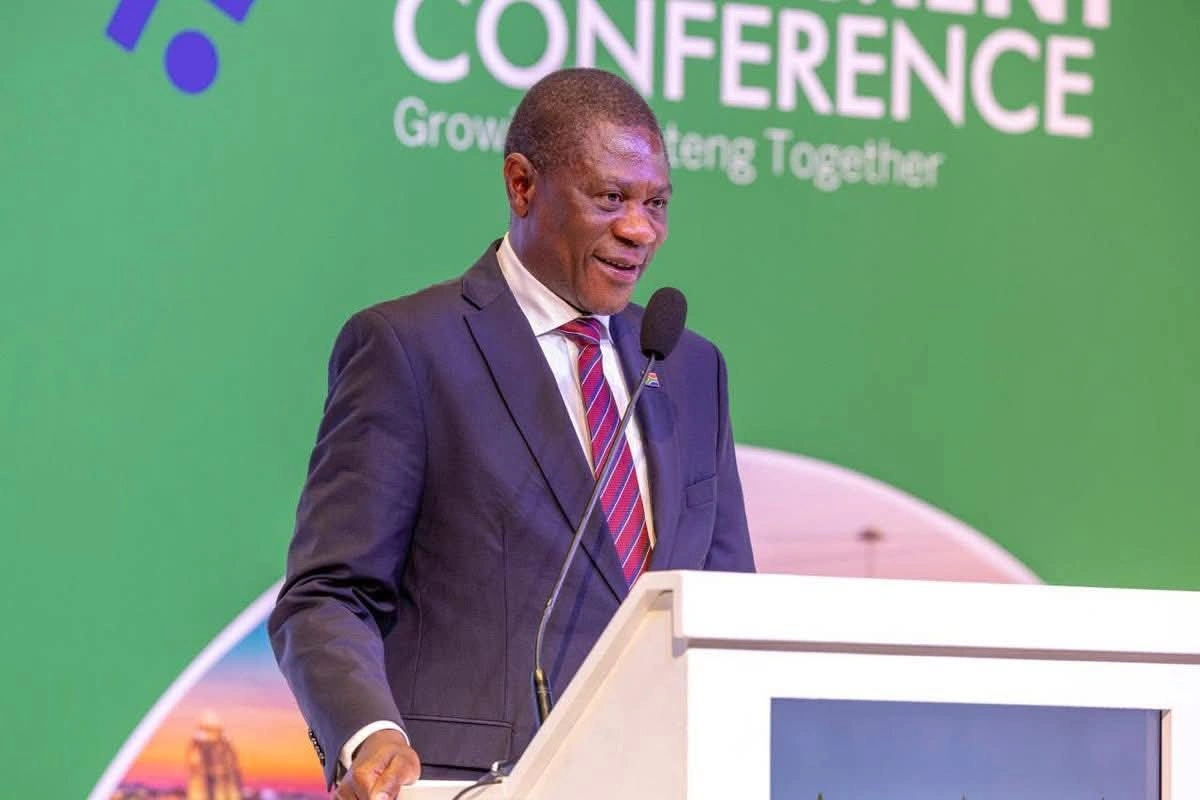
Deputy President Paul Mashatile has urged investors and business leaders to deepen partnerships with government to unlock economic growth, create jobs, and boost South Africa’s industrial capacity.
Speaking at the Gauteng Investment Conference 2026 on Thursday (April 9), Mashatile emphasised that collaboration between the public and private sectors is critical to driving sustainable development and long-term economic resilience.
He highlighted that businesses have a key role to play by investing in skills development, supporting localisation, and integrating small enterprises into broader value chains.
“Re-industrialisation is a practical, forward-looking strategy. It recognises that productive capacity is the foundation of sustained growth,” Mashatile said.
“It must result in technology-driven factories, expanded industrial output, revitalised industrial parks and Special Economic Zones, strengthened local supply chains, and dignified jobs at scale.”
The Deputy President added that government must create an enabling environment for investment by ensuring policy certainty, improving regulatory processes, and strengthening coordination across all levels of government.
He said efforts are underway to attract private capital alongside development finance institutions and commercial lenders, while ensuring accountability and effective project implementation.
Mashatile stressed that infrastructure remains a critical pillar of industrialisation. He pointed to the need for reliable energy supply, efficient logistics systems, water security, and modern digital infrastructure.
“Without reliable energy, efficient logistics, water security, and modern digital infrastructure, industrialisation cannot take place,” he said, noting ongoing investments to stabilise energy supply and improve rail, ports, and water systems.
Deputy President Mashatile also underscored the growing importance of digital industries, saying the future of industrialisation is increasingly driven by technology.
He identified sectors such as data centres, artificial intelligence, fintech, and cloud infrastructure as key drivers of economic transformation, positioning Gauteng as a potential leader in the digital economy.
On the continental front, Mashatile highlighted the role of the African Continental Free Trade Area in unlocking Africa’s economic potential. The agreement aims to integrate 55 African countries into a single market of approximately 1.4 billion people with a combined GDP of about $3.4 trillion.
“Africa remains resource-rich but value-chain poor,” he said. “AfCFTA gives us a platform to build regional value chains, expand intra-African trade, and industrialise at scale.”
He noted that the success of the agreement will depend on improved cross-border infrastructure, reduced trade barriers, and stronger support for African businesses.
Mashatile further stressed that investment must translate into tangible outcomes for citizens.
“Investment must translate into production. Production must translate into jobs. And jobs must translate into improved livelihoods,” he said.
He called for inclusive industrial growth that benefits young people, township economies, and small businesses, ensuring that economic expansion leads to shared prosperity.
The Gauteng Investment Conference 2026 brought together global investors, African governments, municipal leaders, development finance institutions, banks, and private sector stakeholders.
The platform aims to strengthen Gauteng’s position as Africa’s leading investment hub.
The conference builds on the success of its inaugural edition in 2025, which secured R312 billion in investment pledges. It forms part of the provincial government’s broader strategy to attract R800 billion in new investments over three years.
“Through the Gauteng Investment Conference, we are sending a clear message: South Africa is open for business, and Gauteng is ready for execution,” Mashatile said.
He concluded by reaffirming government’s commitment to improving regulatory timelines, supporting investors throughout project lifecycles, and ensuring that investment commitments translate into measurable economic impact and inclusive growth.