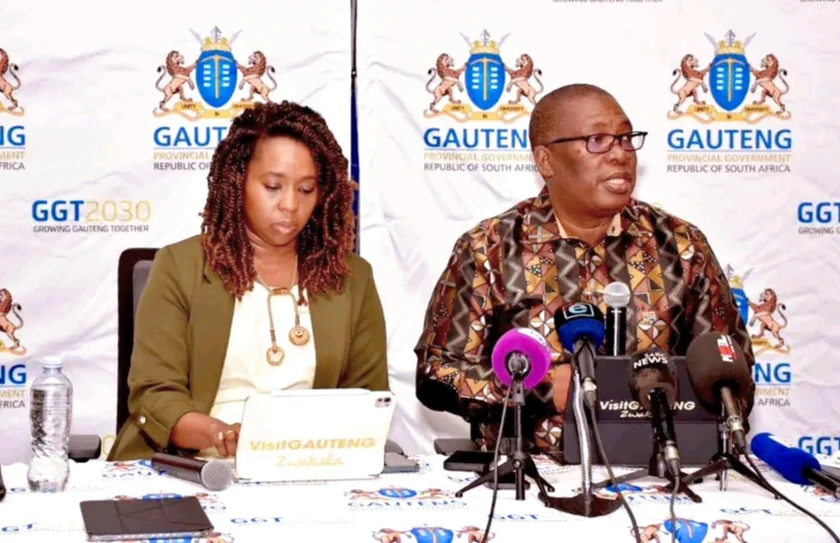
Gauteng Premier Panyaza Lesufi has labelled the ongoing foot-and-mouth disease (FMD) outbreak a national animal health crisis, warning that its impact threatens food security, livelihoods and the agricultural economy if not urgently contained.
Lesufi was joined by MEC for Agriculture and Rural Development Vuyiswa Ramokgopa during a media briefing held in Johannesburg on Monday, January 27, where the provincial government outlined an intensified, coordinated response following a special Executive Council (EXCO) meeting over the weekend.
“The Foot-and-Mouth Disease outbreak, which has been unfolding over several months, has reached the level of a nationwide animal health crisis,” the Premier said, adding that the national Department of Agriculture is considering tabling a declaration of a national state of disaster
Outbreak linked to illegal cattle movement
According to the Gauteng Government, investigations have traced the origin of the outbreak in the province back to April 2025, when cattle were unlawfully transported from an infected zone in KwaZulu-Natal to the West Rand for auction.
As of 23 January 2026, Gauteng is actively managing 195 laboratory-confirmed outbreaks, with an estimated 261,000 animals affected, making it one of the hardest-hit provinces in the country
“This crisis has serious consequences for the economy and society at large. It disrupts trade, threatens jobs in the livestock sector, and affects the income of small-scale and community farmers,” the Premier stated.
Ramped-up multi-stakeholder response
Recognising Gauteng’s position as a national logistics hub and a high-risk area for illegal livestock movement, the provincial government has adopted an accelerated multi-stakeholder rapid response approach, aligned with the National FMD Strategy but aimed at faster virus suppression.
“The goal of the provincial government is to quickly suppress the virus and achieve disease freedom status as soon as possible, while complying with national and international standards,” the statement said.
Key interventions already implemented include:
- R16 million redirected from the Comprehensive Agricultural Support Programme (CASP) towards vaccines, testing, cleaning supplies and mobile veterinary units
- More than 286,000 vaccine doses administered, with 90,000 additional doses ordered
- Strict quarantine measures on all infected farms
- Direct engagement with farming communities to combat misinformation and improve compliance
Vaccines currently used in the province are sourced from Botswana, with the rollout coordinated alongside the National Department of Agriculture.
EXCO brings more departments on board
Following the special EXCO (Provincial Cabinet) meeting, the government resolved to intensify containment measures by mobilising additional departments and municipalities.
The Departments of Community Safety, Transport, Environment and COGTA, together with local municipalities and the security cluster, have been formally directed to participate in the FMD rapid response.
Roadblocks, checkpoints and route controls will be established in identified high-risk areas, including access routes near Dinokeng, where valuable disease-free buffalo populations are under threat.
“All departments must work together to combine existing systems and technologies to improve how we track vehicles and animals, leading to better disease surveillance and enforcement,” MEC Ramokgopa said
Free services for community farmers
MEC Ramokgopa confirmed that vaccines and veterinary services remain free for local and community-based livestock farmers through Gauteng Veterinary Services.
While no dedicated budget has yet been allocated for local vaccine manufacturing, the province has added its voice to calls for domestic production capacity, led by a fully resourced Agricultural Research Council (ARC), to reduce reliance on imports in future outbreaks.
Call for compliance and responsible livestock movement
Authorities reiterated that livestock movement is not banned but strictly regulated. All movements must be accompanied by:
- An owner declaration
- A recipient undertaking to isolate animals for at least 28 days
- All stock vaccination and transport documentation as per the legal framework set.
The provincial government also stressed the importance of community education, particularly where livestock is transported for traditional ceremonies.
“No province can overcome this challenge in isolation,” the MEC said, urging farmers, traders and the public to rely only on official information and to fully comply with veterinary regulations