
Gauteng Govt records R144.4 billion spending
As of the end of January 2026, total provincial receipts amounted to R149.2 billion, representing 83.7% of the budgeted provincial receipts.

The Gauteng Provincial Government has spent R144.4 billion of its adjusted R175.6 billion budget by the end of January 2026, as departments accelerated expenditure to respond to mounting service delivery pressures.
This was revealed by Gauteng MEC for Finance and Economic Development, Lebogang Maile, in a media statement outlining the province’s financial performance for the period 1 April 2025 to 31 January 2026.
The province entered the 2025/26 financial year with a main budget of R172.3 billion, which was later adjusted to R175.6 billion and adopted by the Gauteng Provincial Legislature.
Maile said although the budget was significant, it remained insufficient to address Gauteng’s structural challenges as the country’s most populous and fastest-growing province.
“Gauteng is operating under a difficult economic environment – one that is characterised by geopolitical tensions, slow growth, high levels of unemployment and a cost-of-living crisis,” Maile said.
He added that metropolitan municipalities with high population density face greater competition for limited resources.
Cash position and revenue collection
As of the end of January 2026, total provincial receipts amounted to R149.2 billion, representing 83.7% of the budgeted provincial receipts.
Of this amount, R115.67 billion came from the Provincial Equitable Share, while R25.7 billion was from conditional grants allocated by National Treasury in line with the Division of Revenue Act. Provincial financing contributed R1.8 billion.
Own revenue collection stood at R5.9 billion, which is 70% of the R8.4 billion annual target. This is below the straight-line projection of 83% for the period under review.
Maile emphasised that revenue from provincial sources such as motor vehicle licences, gambling and betting taxes, hospital patient fees and interest earned on investments remains critical.
“That is why we must continuously meet our revenue targets. I will outline some of the key and strong measures that we are taking to ensure that we realise this objective when I present the Provincial Budget to the Legislature on the 10th of March,” he said.
Departmental spending trends
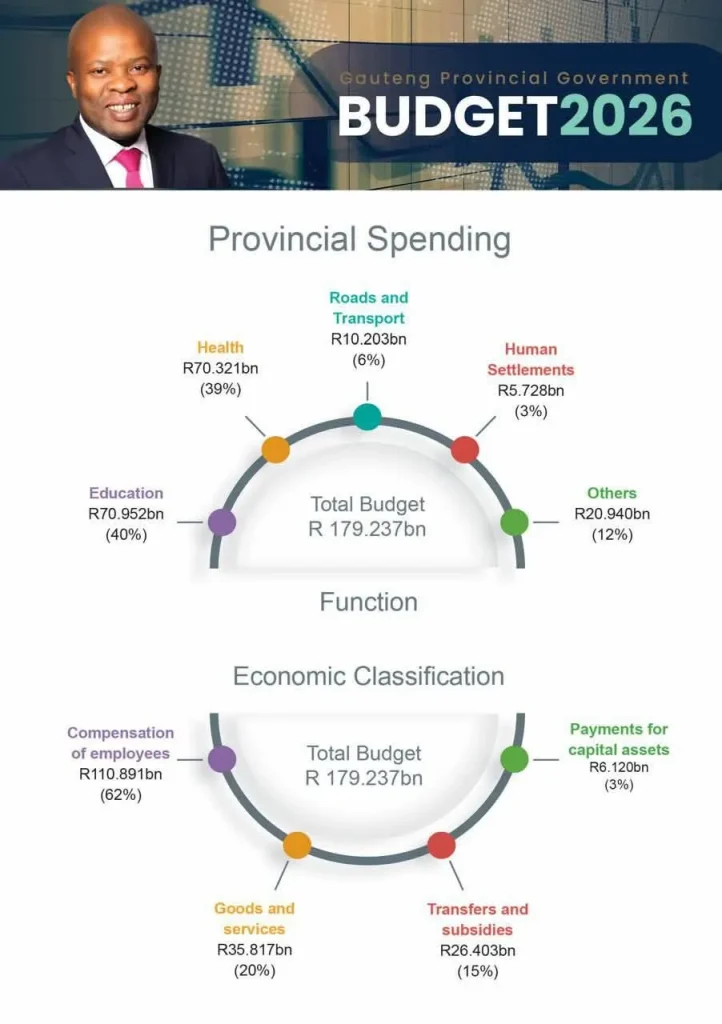
Overall expenditure of R144.4 billion represents 82.2% of the adjusted budget.
The largest spending departments remain Education and Health. The Department of Education spent R58.6 billion, or 85% of its adjusted budget, driven by scholar transport, school nutrition and municipal services.
The Department of Health spent R55.4 billion, or 81% of its adjusted budget. Maile noted that Health is experiencing budget pressures under the HIV/AIDS sub-programme due to the defunding by USAID under the US President’s Emergency Plan for AIDS Relief (PEPFAR).
The Department of Social Development spent R4.8 billion, or 85% of its adjusted budget. “This department has seen a significant increase in the expenditure for School Uniforms, Dignity Packs and Food Parcels… a reflection of the cost-of-living challenges impacting residents of Gauteng,” Maile said.
Infrastructure spending for the province totalled R10.5 billion of the R13.4 billion adjusted infrastructure budget, translating to 78%.
Spending was driven mainly by projects in Health, Education, Infrastructure Development and Roads and Transport.
However, some delays were attributed to project implementation challenges and the builder’s holiday period.
Concerns over overspending
While commending departments for driving expenditure on key projects and programmes, Maile raised concerns about projected overspending in certain areas.
“We are concerned about projected overspending in some departments due to over-commitments of budgets and accruals. More work still needs to be done to manage personnel numbers especially in labour intensive departments,” he said.
To address this, Provincial Treasury has issued a Compensation of Employees’ Instruction Note to ensure that vacant posts are filled only where confirmed budgets are available.
Commitment to transparency
Maile reaffirmed the Provincial Treasury’s commitment to accountability and transparency.
“The Provincial Treasury remains deeply committed to the principle of good governance, at the heart of which is accountability, transparency, and responsiveness,” he said.
He added that the department would continue to provide residents, businesses and the media with information on how public funds are spent, maintaining what he described as an open-door policy within the confines of the law.
Through sound financial management, Maile said, the provincial government remains committed to improving service delivery and realising a better life for all Gauteng residents.