
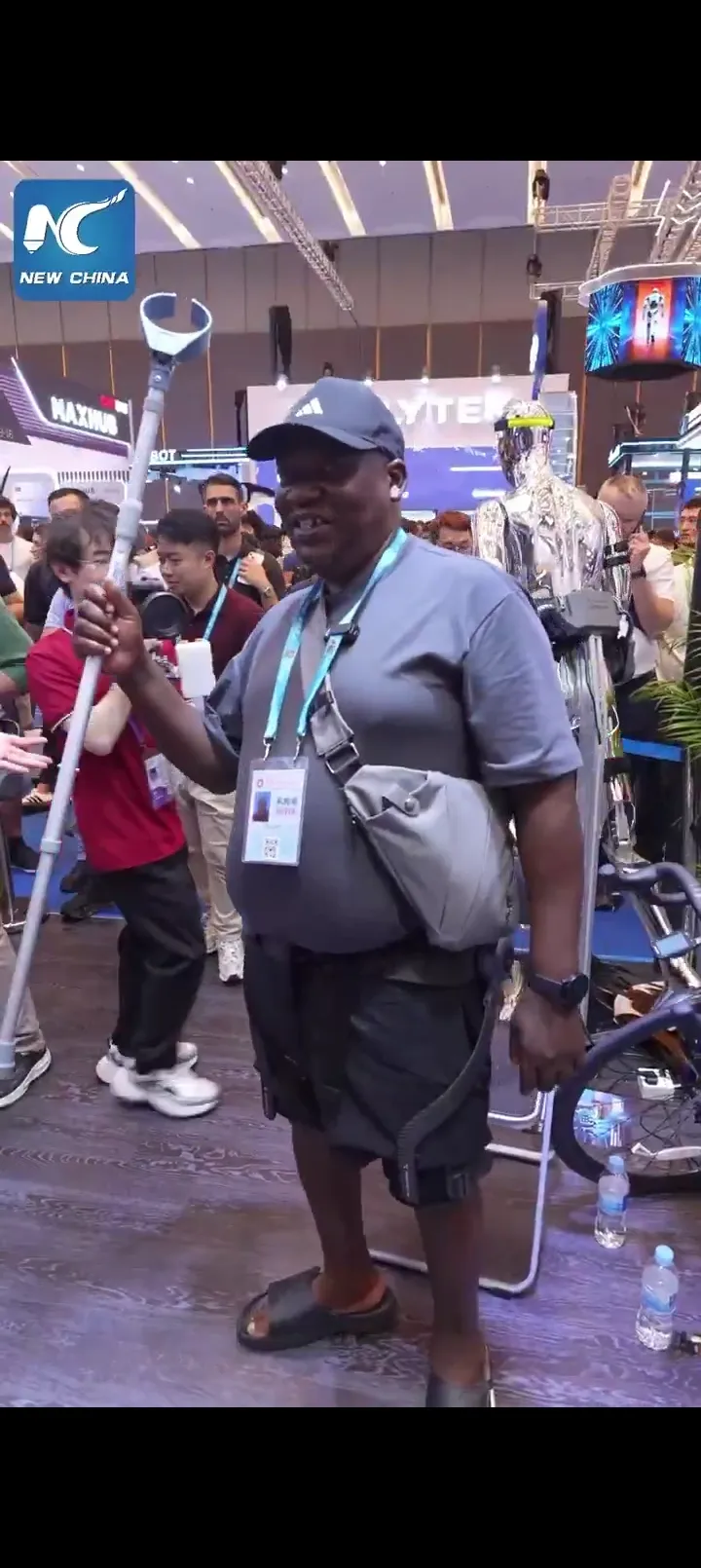

At the bustling 139th Canton Fair, a Zimbabwean merchant who arrived relying on crutches walked away unaided, thanks to a cutting-edge Chinese wearable exoskeleton.
In a viral moment captured by Xinhua News, the entrepreneur tested the device at a robotics booth, discarded his crutches, and strolled freely among exhibitors. Impressed by its instant impact, he purchased it on the spot and declared his mission: to introduce the tech across Africa.
The exoskeleton, a lightweight lumbar-assist model developed by a Chinese robotics firm, uses advanced sensors and motors to support lower-body movement. It enables users with mobility impairments – from injuries, polio, or age-related conditions – to stand and walk with minimal effort.
For the Zimbabwean buyer, it represented more than a gadget; it was a gateway to independence and a business opportunity in a continent where over 80 million people live with disabilities, many lacking access to affordable aids.
This scene underscores China’s growing leadership in assistive technologies tailored for real-world needs in developing regions.
The Canton Fair, a global trade hub running April 15 to May 5, 2026, has spotlighted such innovations in its advanced manufacturing and robotics sections. Chinese firms are not only demoing but exporting these solutions, bridging gaps in healthcare and rehabilitation where traditional options remain costly or unavailable.
Beyond exoskeletons, China is advancing a suite of assistive devices poised to benefit African communities. Intelligent prosthetic limbs, pioneered by companies in Hangzhou and elsewhere, incorporate AI and sensors for natural gait adjustment.
Amputees in China have used them to rock climb, play piano, and perform calligraphy – feats now within reach for African users through exports. Bone-conduction hearing aids from Shanghai’s Boin Hearing Technology offer clear, comfortable sound for those with sensorineural loss, a common issue in regions with limited medical infrastructure. These devices are safer and more affordable than many Western alternatives.
Additional breakthroughs include AI-powered vision assistance systems that combine real-time obstacle detection, tactile feedback, and audio guidance for the visually impaired. Smart wheelchairs and barrier-free mobility solutions are also gaining traction, with China exporting to markets including Kenya, Egypt, and Zimbabwe. At domestic expos, such as the Care & Rehabilitation Expo, these technologies have drawn international praise for empowering the elderly and disabled.
For Africa, the implications are profound. Disabilities often stem from accidents, conflict, or preventable diseases, yet assistive devices reach fewer than 10% of those who need them. Chinese innovations stand out for their durability, lower cost, and adaptability to challenging environments – from rural paths to urban settings. Through platforms like the Canton Fair, African entrepreneurs can source, distribute, and even localize production, fostering jobs and training.
As the Zimbabwean merchant prepares to ship his exoskeleton home, his story highlights a broader trend: practical Chinese engineering meeting urgent African needs. From restoring mobility to enhancing senses, these technologies promise dignity, productivity, and inclusion. With growing Sino-African partnerships, the future of assistive care in the continent looks not just promising – but transformative.





This hit me a bit differently because I’ve been helping an older relative look into mobility aids, and honestly the biggest problem is not “does cool tech exist?” but “can anyone actually get it, afford it, and use it where they live?” That’s why the part about someone from Zimbabwe seeing the device at the Canton Fair and immediately thinking about bringing it back home felt more real to me than the viral angle. After reading this I looked up a more basic explainer here: https://www.exoskelette.com/was-ist-ein-exoskelett/ mainly because I wanted something simple I could send to family, and it helped me separate actual exoskeleton support from the usual sci-fi image people have. Do you think access and distribution are now the bigger issue in Africa, more than the technology itself?
I’d be really interested if you have some more insight