Chinese Language Day Highlights Growing Ties and Opportunities in South Africa
China is one of South Africa’s major trading partners, and proficiency in Chinese opens doors in business, technology, diplomacy, and tourism.

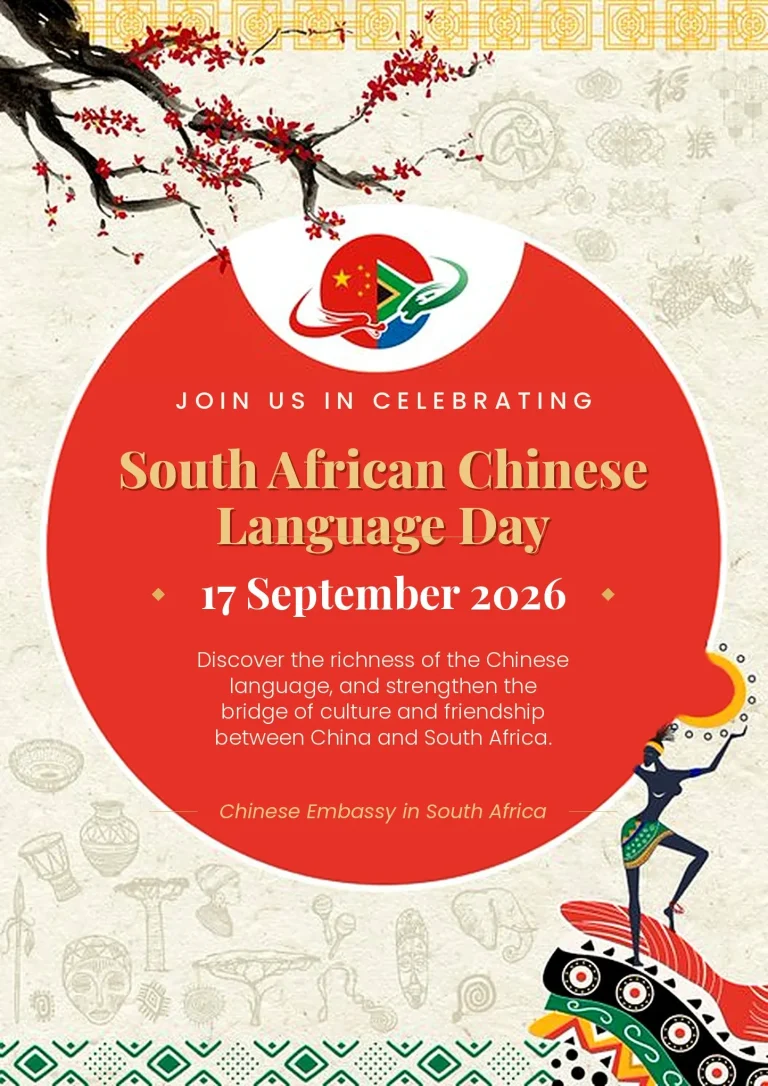
As South Africa marked its annual Chinese Language Day on 17 September, Chinese Ambassador Wu Peng highlighted the deepening cultural and people-to-people bonds between the two nations.
In a message celebrating the occasion, he noted how the meeting of China’s profound culture with South Africa’s diverse heritage creates vibrant exchanges that enrich the world.
Established jointly by China and South Africa in 2019, South African Chinese Language Day falls on 17 September each year. It underscores the rising importance of Mandarin as a bridge for mutual understanding, economic cooperation, and educational opportunities.
China is one of South Africa’s major trading partners, and proficiency in Chinese opens doors in business, technology, diplomacy, and tourism.
Young South Africans increasingly view the language as a practical skill for accessing China’s advancements in fields like green technology, artificial intelligence, and manufacturing.
Mandarin was formally incorporated into South Africa’s national education system in 2015 as a second additional language. A curriculum followed in 2016, allowing learners from Grade 4 through to matric to study it as an elective. It entered the National Senior Certificate examinations in 2018. While numbers remain modest compared to official languages—Independent Examinations Board figures showed growth from 62 candidates in 2024 to 91 in 2025—the trend reflects steady interest amid resource constraints.
South Africa hosts the highest number of Confucius Institutes in Africa, with seven institutes, two independent Confucius Classrooms, and multiple teaching centres. These institutions, located at universities including the University of Cape Town, Stellenbosch University, University of Johannesburg, Rhodes University, University of the Western Cape, and the University of Venda (home to a unique green technology-focused institute), offer language courses ranging from beginner to advanced levels. Many provide free or low-cost classes open to the public, cultural workshops in calligraphy, martial arts, and tea ceremonies, HSK proficiency testing, and pathways to scholarships for study in China.
Beyond formal education, community programmes and Chinese cultural centres support learners of all ages. Officials from various government departments have also taken courses, strengthening practical bilateral engagement.
For those interested in starting or advancing their studies, contact local Confucius Institutes through university websites, inquire at participating schools, or explore Chinese Embassy resources. Online options and placement tests are widely available.
As Ambassador Wu Peng emphasised, language learning fosters colourful exchanges that benefit both nations and their people.
The celebration of Chinese Language Day reinforces how linguistic skills continue to weave stronger threads of friendship and shared opportunity across the Rainbow Nation.