New Finance MEC Dunga Unveils Recovery Plan
Dunga warned that weak governance, collapsing infrastructure and unfunded municipal budgets were threatening service delivery across the province.

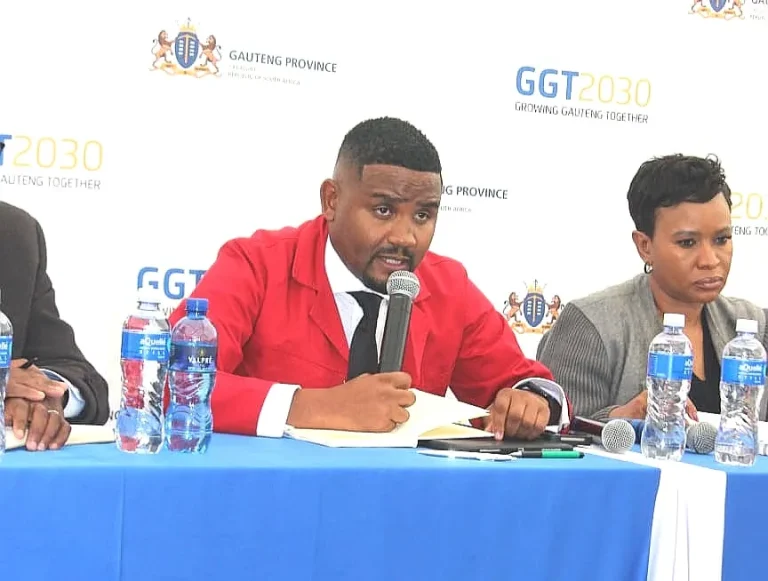
Newly appointed Gauteng MEC for Finance Nkululeko Dunga has painted a stark picture of the province’s financial position, warning of mounting debt, unpaid invoices, weak revenue collection and deteriorating infrastructure, while promising sweeping reforms to stabilise the province’s finances.
Speaking at a media briefing held at Dube Hostel in Soweto on Thursday (May 14), Dunga said Gauteng was facing “deep social contradictions” despite remaining South Africa’s economic hub.
The province contributes more than a third of the country’s GDP but continues to battle unemployment, inequality and growing pressure on public services.
The newly appointed MEC, deployed by the Economic Freedom Fighters on 1 April 2026, said his administration would prioritise financial discipline, accountability and rebuilding state capacity.
He stressed that provincial finances “belong to the people, not only to investors and institutions.”
Dunga linked Gauteng’s financial challenges to broader global instability, including conflict in the Middle East, rising fuel prices and slowing economic growth. According to the speech, global inflation and energy costs are increasing the cost of transport, food and electricity, putting additional pressure on households and government spending.
Domestically, South Africa’s economy grew by only 1.1% in 2025, while unemployment remains severe. Gauteng’s expanded unemployment rate now stands at 40.6%, with millions of South Africans still unable to find work.
The province is implementing a R179.2 billion budget for the 2026/27 financial year, but Dunga warned that Gauteng’s rapid population growth and migration pressures are not adequately reflected in national funding allocations.
Education and Health together account for roughly R137 billion — about 77% of the total budget — leaving limited funding for infrastructure, housing, transport and economic development.
Dunga acknowledged worsening conditions in schools and hospitals, including overcrowded classrooms, inadequate infrastructure and medicine shortages, saying these reflected a fiscal system under severe pressure.
The MEC also revealed that Gauteng still has approximately R36.5 billion in unresolved historical irregular expenditure, with the largest amounts linked to the Health, Education and Human Settlements departments.
“Heads must roll where necessary,” me Dunga said, warning that negligence and procurement failures would no longer be tolerated.
A major concern raised during the briefing was the province’s growing backlog of unpaid invoices. Provincial accruals and unrecognised expenditure commitments have climbed to around R9.3 billion, with more than R4.9 billion overdue beyond 30 days.
Dunga said delayed payments were hurting township businesses and small enterprises that had already delivered services to government.
“The direct consequence of this situation is collapsing businesses, job losses, weakening local economic activity and declining confidence in the state,” he said.
The speech also highlighted serious financial instability in Gauteng municipalities. Municipal debtors now total approximately R173.3 billion, while creditors amount to at least R34.3 billion, excluding underreported debt owed to Eskom and Rand Water.
Dunga warned that weak governance, collapsing infrastructure and unfunded municipal budgets were threatening service delivery across the province.
Municipalities including Emfuleni, Sedibeng, Lesedi and Merafong are already undergoing intensified provincial intervention measures.
To address the crisis, Gauteng Treasury plans to fill about 40 critical positions, modernise financial systems and strengthen procurement oversight.
The province is also exploring new revenue collection systems, including direct provincial payment platforms for licensing and other government services to reduce leakages and improve accountability.
Among the longer-term initiatives under consideration are a provincial state-owned bank and a provincial pharmaceutical company aimed at reducing healthcare procurement costs.
He additionally raised concern over violence and intimidation targeting public officials involved in anti-corruption work, referencing the killings of officials including the late Babita Deokaran.
In closing, Dunga warned that Gauteng’s current financial resources are insufficient to meet growing demands linked to healthcare, education, housing, transport and urbanisation. However, he insisted the provincial government remained committed to improving governance and ensuring public money delivers visible results for communities.
“The success of public finance management will ultimately not be measured by accounting processes alone, but by whether communities experience improvements in schools, clinics, roads, housing, transport, municipal services, public safety and broader living conditions across Gauteng,” Dunga concluded.