Gauteng Education Looks to End Decentralised School Funding Model Amid Growing Debt Crisis
Maile warned that non-payment of municipal accounts has already resulted in electricity and water disconnections at several schools, disrupting teaching and learning.

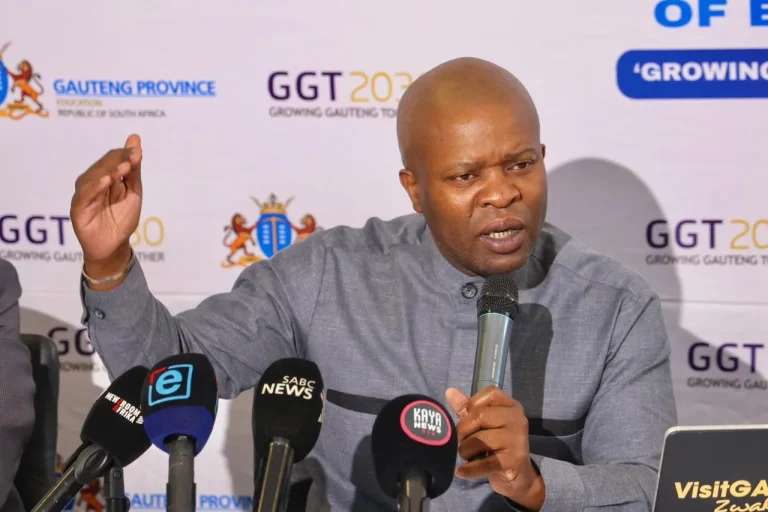
Gauteng MEC for Education, Sports, Arts, Culture and Recreation Lebogang Maile says the Gauteng Department of Education is reviewing its decentralised school funding model as growing municipal debt and service disruptions continue to affect teaching and learning across the province.
Speaking during a media briefing on the state of education in Gauteng, Maile said the department is reconsidering the model which allows schools to manage their own finances and pay for services such as electricity, water, sanitation and refuse removal.
The MEC revealed that public schools in Gauteng currently owe municipalities more than R583.9 million in unpaid municipal accounts that are over 60 days overdue. Gauteng schools also owe Eskom more than R6.3 million.
According to the department, the City of Johannesburg accounts for the largest portion of the debt at R390.7 million, followed by the City of Ekurhuleni at R75.1 million and the City of Tshwane at R51.7 million.
Maile said the decentralised system was introduced to promote financial autonomy and accountability at school level.
“The primary aim of this system is to promote financial autonomy and accountability at school level,” Maile said.
Under the model, schools and School Governing Bodies (SGBs) are responsible for managing budgets, procurement and municipal payments without relying on centralised departmental approval.
The department said the approach was intended to improve efficiency, strengthen governance and allow schools to respond quickly to operational needs. However, the MEC admitted that the system has created major challenges, particularly for no-fee and low-income schools struggling with rising municipal tariffs and operational costs.
The crisis comes as Gauteng’s education system continues to face mounting pressure from rapid population growth and overcrowding in schools.
The province’s learner population has more than doubled from 1.4 million learners in 1995 to over 2.8 million learners in 2026.
At the same time, infrastructure demands continue to outpace available funding. The Gauteng Department of Education’s infrastructure budget increased from R1.63 billion in the 2021/2022 financial year to R2.84 billion in 2025/2026, but the department says this is still not enough to address infrastructure backlogs and maintenance challenges.
Maile warned that non-payment of municipal accounts has already resulted in electricity and water disconnections at several schools, disrupting teaching and learning.
“Schools without electricity cannot operate computer labs, lighting, or administrative systems, while water cuts create sanitation and health risks for learners and staff,” the department stated.
The department also accused some municipalities of overcharging schools through estimated billing, incorrect tariff classifications and historical debt transfers. Some schools have allegedly been billed under commercial tariffs instead of educational tariffs, placing further financial pressure on already struggling institutions.
Maile said the department is now engaging stakeholders to explore possible alternatives to the decentralised model while ensuring that schools remain focused on their core mandate of teaching and learning.
“We are in the process of engaging with the necessary stakeholders to assess what can be done to strengthen teaching and learning while mitigating and eliminating the challenges,” he said.