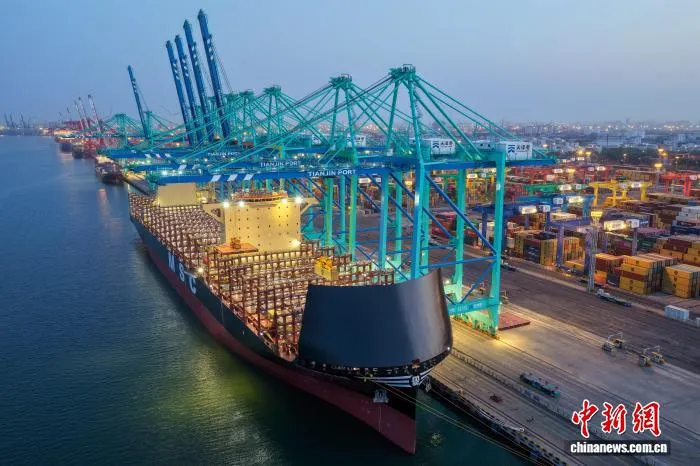

Tianjin Port in northern China has launched its first direct shipping service to South Africa in recent years.
The new route, which commenced operations on April 18, underscores the deepening maritime connectivity and trade integration between the two regions amid evolving global supply chain dynamics.
The service deploys a fleet of 12 vessels, each with a capacity of 140,000 deadweight tonnes, operating on a reliable weekly schedule. It establishes a direct link between Tianjin Port and South Africa’s key gateways: the modern deep-water port of Ngqura (Coega) and the bustling Durban port. This development is expected to optimize logistics for the Beijing-Tianjin-Hebei (BTH) region, one of China’s most dynamic economic hubs, while enhancing cargo flow to and from Africa.
Transit times have been notably improved, with the shortest voyage now approximately 40 days. This marks a substantial gain in efficiency, offering greater cargo compatibility and logistical flexibility compared to previous indirect routings that often involved transshipments and longer delays. By streamlining maritime transport, the route reduces costs and uncertainties for businesses on both sides, facilitating smoother movement of manufactured goods, machinery, electronics, and raw materials.
The launch aligns with broader China-Africa relations, which have seen robust growth in recent years. South Africa remains China’s largest trading partner on the continent, with bilateral trade reaching $53.58 billion in 2025.
China’s direct investment stock in South Africa has surpassed $11.7 billion, focusing on sectors such as infrastructure, energy, automotive manufacturing, mining, and agriculture.
This new shipping link is poised to further accelerate these ties by providing northern Chinese exporters with reliable access to South African markets and enabling South African producers—particularly in agriculture and minerals—to reach Chinese consumers more efficiently.
Ngqura Port, integrated with the Coega Special Economic Zone, serves as a strategic industrial hub, while Durban handles significant container volumes and acts as a regional gateway.
The route supports South Africa’s ongoing port modernization efforts and complements China’s involvement in African port development projects across the continent.
Analysts view this initiative as part of a larger strategy to build resilient trade corridors. In an era marked by geopolitical tensions and disruptions in traditional routes like the Red Sea, direct China-Africa maritime links offer greater stability and autonomy for bilateral commerce. It also reflects the spirit of the Forum on China-Africa Cooperation (FOCAC), emphasizing mutual benefit, infrastructure connectivity, and sustainable development.
For the BTH region, the service is expected to invigorate foreign trade, supporting industries in Beijing, Tianjin, and Hebei province. Local businesses stand to gain from reduced shipping times and enhanced supply chain reliability, potentially increasing export volumes to Africa.
This development adds momentum to China’s maritime cooperation with Africa, where Chinese enterprises have contributed to port expansions and logistics improvements in countries from East to West Africa. As both sides pursue high-quality cooperation, such infrastructure links play a pivotal role in translating economic complementarity into tangible growth.
Industry stakeholders anticipate that the new route will not only boost trade volumes but also foster people-to-people exchanges and long-term partnerships. With weekly sailings and substantial vessel capacity, it provides the scale needed to meet growing demand.
As China and Africa continue to navigate global economic shifts—including new tariff policies and green energy transitions—this direct shipping connection symbolizes practical progress in their strategic partnership. It reinforces the commitment to win-win collaboration, positioning maritime infrastructure as a cornerstone for future bilateral relations.