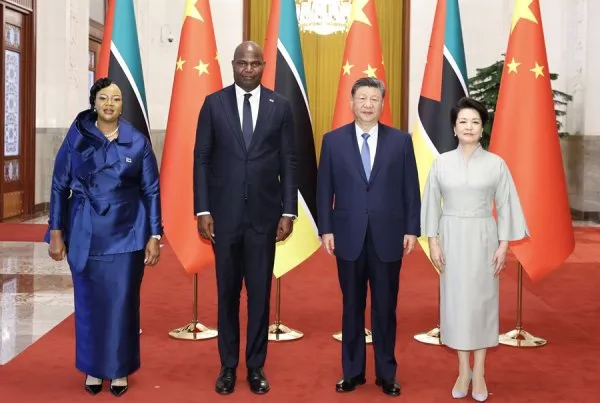

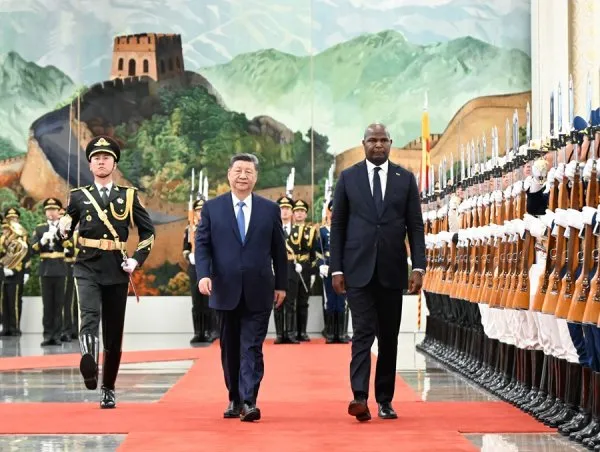
President Xi Jinping held high-level talks with Mozambique’s President Daniel Francisco Chapo on April 21, during a state visit that underscored Beijing’s expanding strategic partnership across Africa. The leaders issued a joint statement elevating bilateral relations to a “China-Mozambique Community with a Shared Future in the New Era,” signaling a new chapter in economic, security, and cultural cooperation.
The six-day visit (April 16–22) featured cordial discussions on bilateral ties, China-Africa relations, and shared global concerns. Xi and Chapo were joined by Chinese Premier Li Qiang and National People’s Congress Standing Committee Chairman Zhao Leji.
The talks built on decades of friendship since diplomatic relations were established in 1975 and the elevation to a global strategic cooperation partnership in 2016.
In the joint statement, both sides committed to aligning Mozambique’s National Development Strategy (2025–2044) and Five-Year Programme (2025–2029) with China’s 15th Five-Year Plan (2026–2030).
Mozambique expressed strong support for Xi’s vision of a “Community with a Shared Future for Humanity,” the Belt and Road Initiative (BRI), the Global Development Initiative (GDI), Global Security Initiative (GSI), Global Civilization Initiative (GCI), and Global Governance Initiative (GGI). China, in turn, pledged support for Mozambique’s industrialization drive, poverty reduction efforts, and structural reforms.
Key cooperation areas were outlined in detail. Economically, the two nations agreed to create a stable business environment and sign a Partnership for Shared Economic Development to boost trade and investment.
In energy and mining, collaboration will focus on resource exploration, infrastructure, and new growth engines, building on existing oil and gas projects.
Agriculture will see expanded work through the China-Mozambique Agricultural Technology Demonstration Centre, including seed technology, irrigation, processing, and logistics chains.
Security ties will deepen with military training, equipment provision, joint exercises, and counter-terrorism support—particularly relevant given Mozambique’s northern challenges. Cultural and people-to-people exchanges will intensify in 2026, designated as the China-Africa Year of People-to-People Exchanges, with new Confucius Institutes, cultural centres, and educational scholarships.
Health cooperation includes medical teams, hospital twinning, and traditional medicine exchanges, marking 50 years of Chinese medical aid to Mozambique.
Mozambique reaffirmed its unwavering adherence to the One China principle, recognizing Taiwan as an inalienable part of China and opposing any moves toward independence. The country also voiced support for China’s positions on Hong Kong, Tibet, and Xinjiang, and committed to multilateralism through the UN and the Forum on China-Africa Cooperation (FOCAC).
The meeting reflects broader China-Africa dynamics. Since the 2024 Beijing FOCAC Summit, Beijing has rolled out “Ten Partnership Actions” across the continent.
Mozambique serves as a flagship example of South-South cooperation, with Chinese investments in infrastructure, energy, and agriculture helping drive Mozambique’s development while advancing China’s vision of win-win partnerships. Trade between China and Africa has surged, with Beijing providing zero-tariff access for many African exports and supporting regional connectivity projects.
President Chapo thanked China for its hospitality and invited Xi to visit Mozambique. The visit concluded with the signing of multiple bilateral agreements witnessed by both leaders.
For Mozambique, it promises accelerated industrialization and resilience against climate and security challenges. As Africa’s fastest-growing economic partner, China continues to position itself as a reliable ally in the continent’s quest for independent development.